Electricity runs quietly beneath everything we do, yet few people realize that our power world operates on two parallel systems: alternating current and direct current. They complement each other, each with its own strengths, lighting cities, driving factories, and powering every corner of our digital lives.
This article aims to make those two systems a little clearer.
What Exactly Are AC and DC?
The distinction begins with the way electric current behaves.
Direct current is a one-way flow of energy.
Batteries, solar panels, and most electronic devices release power that moves in a single, steady direction, forming a calm, unwavering stream of energy.
Alternating current is a rhythmic wave.
Voltage and current oscillate at fixed frequencies, creating a pulsing flow of energy. Most of the world's grids operate at 50 or 60 hertz, the heartbeat of modern power systems.
More than a century ago, these two technologies once stood on opposite sides of a global debate. Edison promote DC while Tesla and Westinghouse championed AC. AC eventually prevailed because it could be easily stepped up and down in voltage, making it ideal for building large, interconnected grids.
But this never meant DC was obsolete. Its natural affinity with electronic devices ensured that it never left the stage.

How Do AC and DC Differ at Their Core?
The differences can be seen across several dimensions:
Transmission and efficiency
AC suits traditional grid distribution.
DC excels in ultra-long-distance, submarine, and high-capacity transmission, where lower losses and stronger controllability give HVDC systems a clear advantage.
Components and architecture
AC systems rely on transformers, reactors, and mechanical switchgear.
DC systems depend heavily on power electronics, offering flexibility but demanding higher control and thermal management capability.
Power quality
Protection mechanisms
AC current naturally crosses zero, making fault interruption easier.
DC has no zero crossing, so breaking faults requires faster, more complex protection schemes.
In short, AC is stable and time-tested, while DC is agile and increasingly vital in emerging applications.
Why Do Urban Power Grids Rely Mainly on AC?
AC became the backbone of modern grids for several key reasons:
The power of transformers
AC can be stepped up or down with simple, robust transformers. High-voltage transmission is faster, low-voltage distribution improves safety, and together they make large-scale power delivery possible.
Large-scale interconnection
AC grids synchronize through frequency, allowing entire cities, regions, and even nations to be linked into a unified system that can be managed as one.
Mature technology and cost advantages
After more than a century of development, AC equipment is mature, standardized, and cost-effective. It forms the trusted backbone of industrial and urban infrastructure.
Still, AC has its limitations: high short-circuit currents, resonance risks, and challenging stability issues. These do not make DC “better,” but they set the stage for the rise of modern DC technologies.

Why Is DC Making a Comeback?
In the last decade, DC has not simply returned; it has surged. Several modern trends are driving DC back into the spotlight.
The digital world runs on DC
Phones, computers, routers, and nearly all electronics operate on DC. Every wall-plug adapter is essentially translating AC into the DC that devices truly need.
Solar and energy storage are reshaping the grid
Solar panels generate DC. Batteries charge and discharge in DC. Historically, these systems had to convert power into AC before interacting with the grid. As DC technologies mature, avoiding unnecessary conversion losses has become the industry norm.
Data centers and AI are pushing DC adoption
Large data centers operate internally on DC. Multi-stage AC/DC conversion quietly erodes efficiency, so many facilities are exploring DC bus architectures to minimize energy loss.
Electric transport is a giant DC ecosystem
EVs, battery packs, and traction systems are fundamentally DC. Even an AC charging pile ultimately converts power to DC inside the vehicle. As charging networks expand, DC’s importance becomes increasingly visible.
Together, these shifts show one clear trend: from energy to mobility, from the home to high-tech industry, DC is embedding itself throughout modern society.


From Expanding Applications to Measurement: The Era of DC Energy Meter Calibration
As DC moves from niche to mainstream, one essential question becomes unavoidable:
How do we measure DC energy accurately?
Solar output continues to rise, storage systems are deployed at scale, EV charging volumes keep breaking records, and data centers are consuming unprecedented amounts of power. What these scenarios share is simple: enormous energy flows are now happening in DC.
Where there is energy flow, reliable measurement must follow.
Accurate, traceable DC energy metering is essential for fair transactions, system reliability, and unified technical standards. And behind every accurate meter is a dependable calibration framework.
But DC metrology is challenging:
• DC signals are steady, demanding extremely high source accuracy
• Application conditions vary widely
• Lacking AC’s natural conveniences such as frequency and zero-cross detection
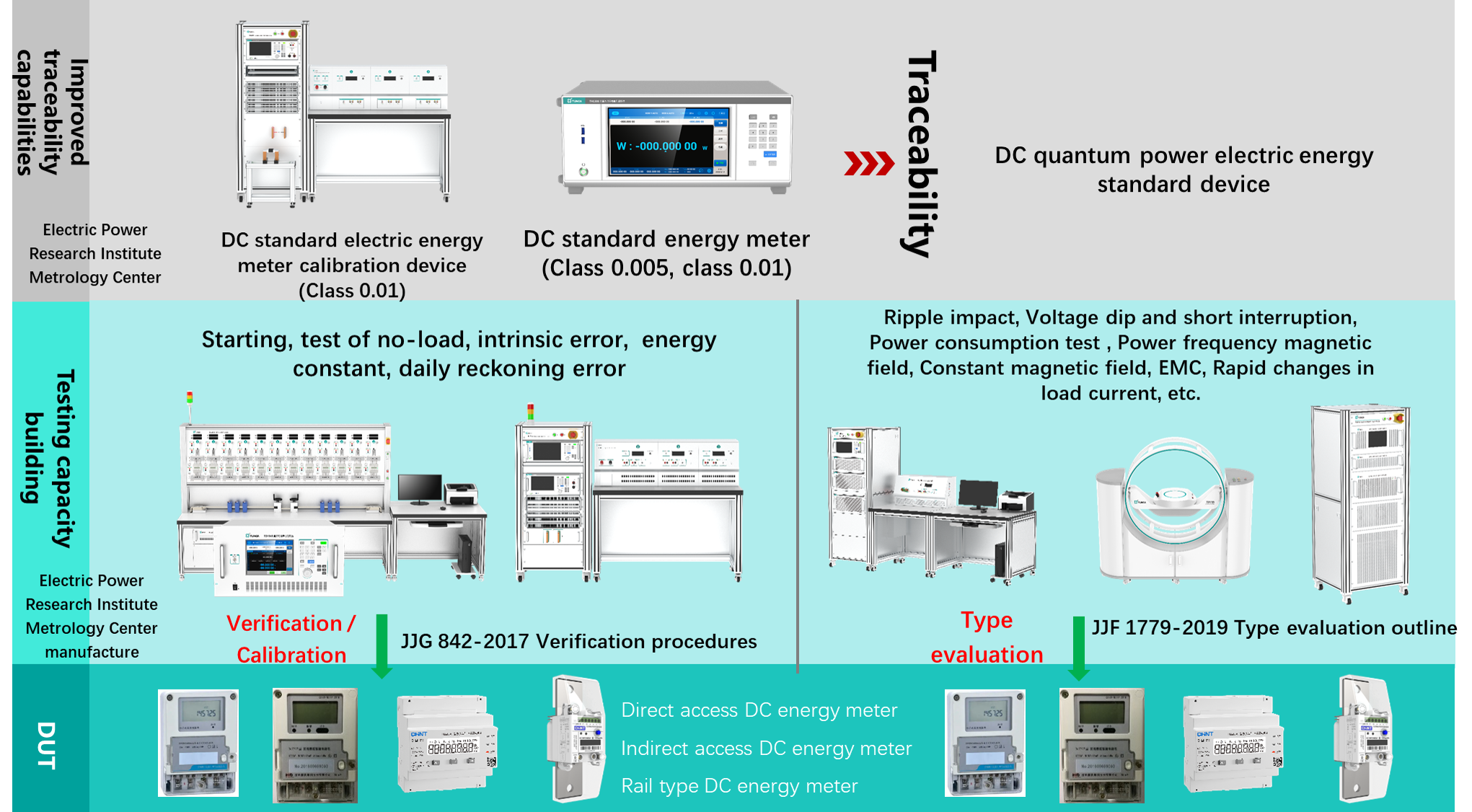
Building DC energy meter calibration capabilities is not optional; it is foundational to the future energy system. The earlier the investment, the stronger the position in the emerging DC ecosystem.
TUNKIA has long invested in this direction, establishing a complete DC calibration architecture covering voltage, current, power, and energy. Our high-precision sources, metrological instruments, standard meters and complete system for DC energy meter test serve metrology institutes, utilities, manufacturers, laboratories, and field inspection needs.

As DC applications expand, this capability is becoming the industry's reference benchmark for reliable measurement and fair energy exchange.
Conclusion
AC and DC are not rivals. They are the two main roads shaping modern energy systems.
AC anchors urban and industrial grids with stability and scale.
DC powers the rise of renewables, EVs, storage, data centers, and digital infrastructure with efficiency and flexibility.
As DC continues to expand, its supporting metrology and calibration systems will become essential to the transparency and credibility of the entire energy ecosystem.
The future of electricity is not “AC or DC” but “AC and DC together,” forming a smarter, more efficient, and more adaptable power world.